Tower Rush free version to practice now
Tower Rush Free Play Demo - Try Before You Deposit
For a game built on timing and precision, that distinction carries weight. Tower Rush rewards practice in ways that slot machines never can. A player who spends a week in demo mode develops reflexes, identifies personal limits, and builds a strategy framework that directly transfers to real-money sessions.
This guide explains what the demo offers, how to access it, what to test during free play, and how to know when the transition to paid mode makes sense.
What the Demo Includes (Everything)
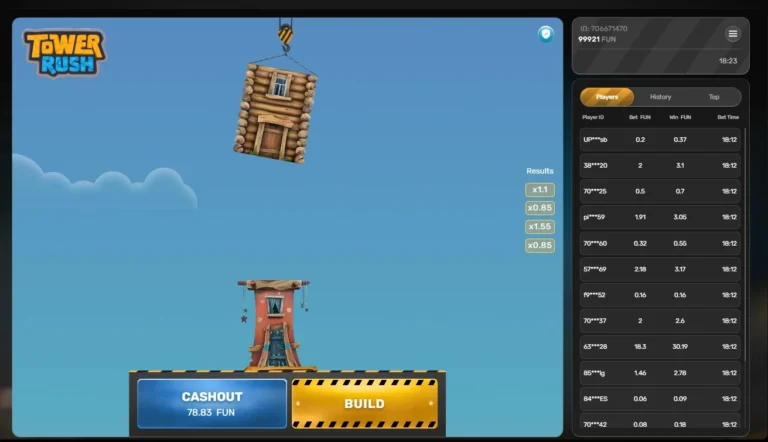
The free play version of Tower Rush replicates the paid experience with zero exceptions on the gameplay side. Here’s what runs identically:
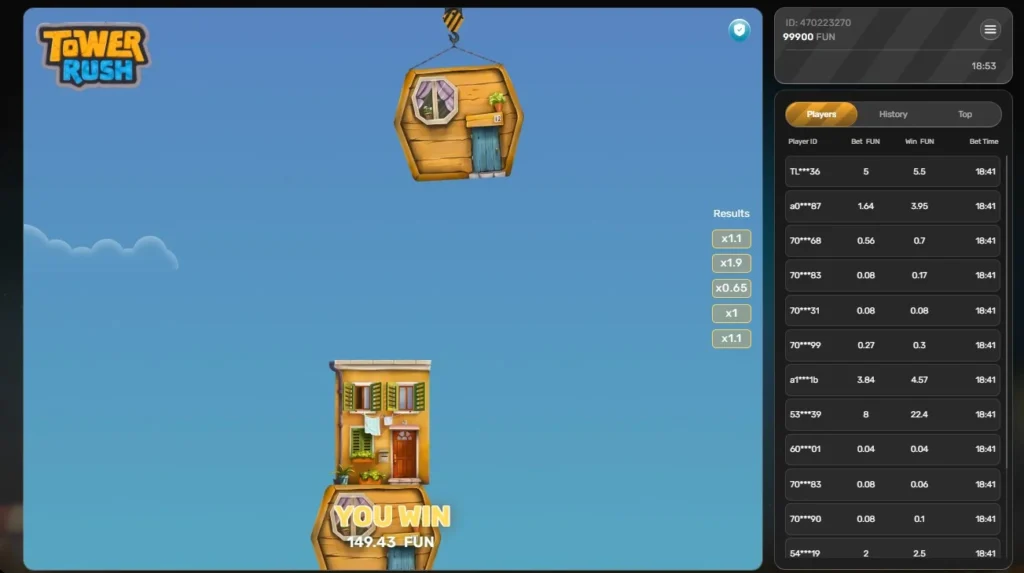
The physics engine. Block oscillation speed, amplitude, and progression follow the same parameters. The crane moves at the same pace. Tolerance zones shrink at the same rate per floor. A player who can consistently reach floor 9 in demo will reach floor 9 in real-money mode with the same consistency.
The three bonuses. Frozen Floor, Temple Floor, and Triple Build appear with the same frequency and the same effects. The RNG governing their distribution doesn’t differentiate between demo credits and actual currency. Testing bonus reactions in free play produces data that’s directly applicable to paid sessions.
The RTP model. The theoretical return sits at 96.12%-97% in both modes. Over a large sample of rounds, the distribution of outcomes mirrors what real-money players experience. Short-term variance exists equally in both modes.
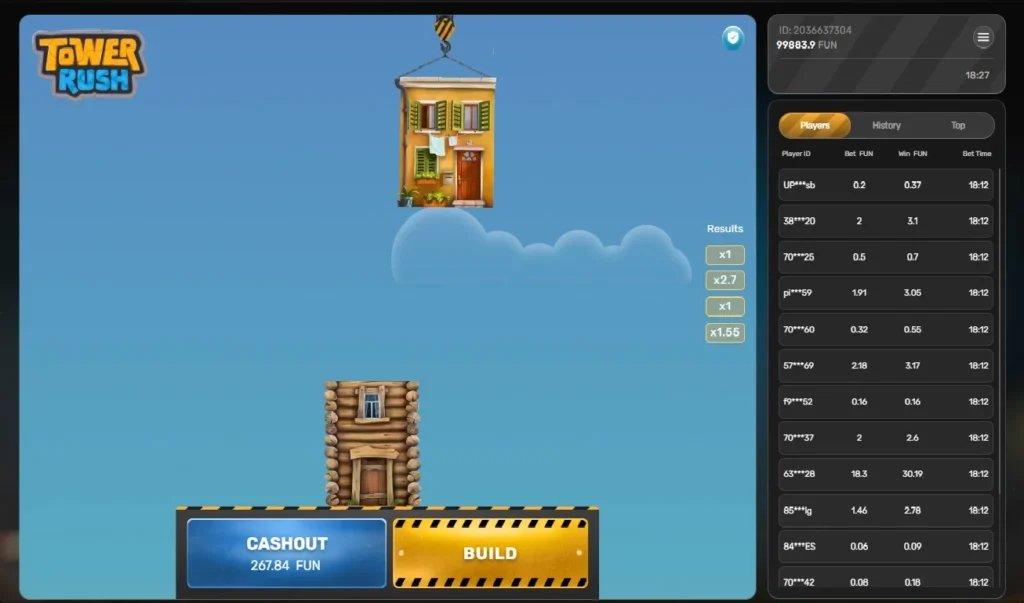
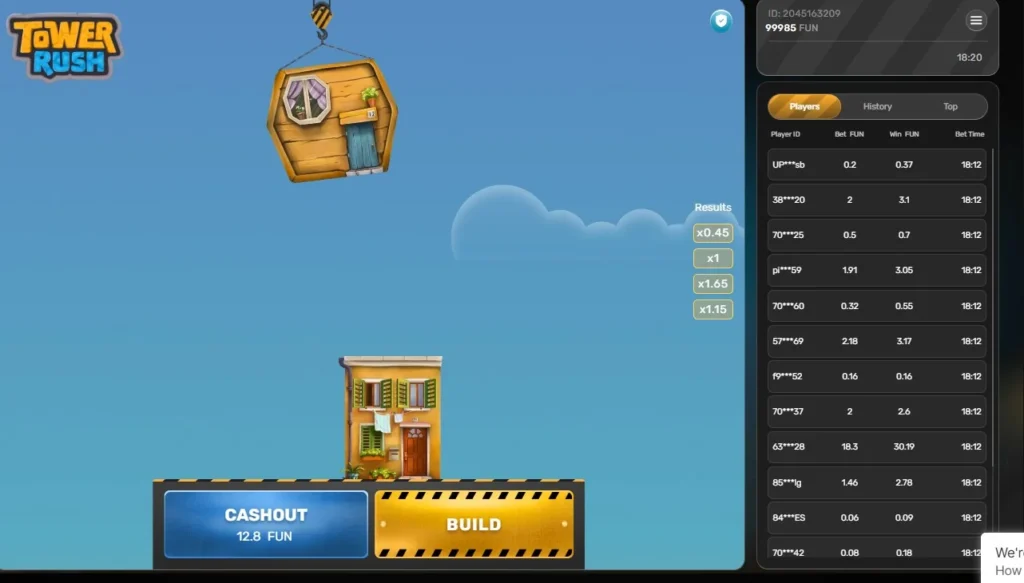
The interface. BUILD and CASHOUT buttons, multiplier display, bet adjustment, session history. Every element behaves identically. A player familiar with the demo interface needs zero adjustment time when switching to real money.
What the demo doesn’t include: actual financial transactions. No deposits, no withdrawals, no KYC verification. The credits reset to a default amount when depleted. There’s no cap on how many rounds can be played or how long a session can last.
Accessing the Demo: Three Routes
Getting into Tower Rush free play takes less than a minute through any of these paths.
Route 1: Casino platform without registration. Most online casinos that host Tower Rush allow demo access directly from the game page. Navigate to the crash games section, find Tower Rush, and look for a “Play for Fun” or “Demo” button. No account creation necessary on the majority of platforms.
Route 2: Casino platform with registration. Some casinos require a free account before granting demo access. The registration process takes 2-3 minutes and asks for basic information (email, username, password). No deposit is required to play in demo mode afterward.
Route 3: Galaxsys portfolio page. The developer sometimes hosts playable demos of their titles on their own website or through partner aggregator sites. This route bypasses casino platforms entirely but availability varies by region.
The fastest path for most players is Route 1. Open a casino in the browser, search for Tower Rush, tap Demo. Playing within 60 seconds of deciding to try the game.
A Testing Protocol That Actually Helps
Random free play is fun but not particularly useful. A structured testing approach extracts maximum value from demo sessions and produces data that improves real-money performance.
Phase 1: Find your precision ceiling (10-15 minutes)
Play 10-15 rounds with a single goal: discover the floor where your block placement becomes unreliable. Don’t cash out early. Let the tower grow until it collapses.
Track results mentally or on paper. If the tower consistently falls between floors 8 and 10, that zone is your precision ceiling. If it regularly survives past floor 12, you have above-average timing for this game.
This number defines your cashout range for real-money play. A player whose towers collapse around floor 9 should set cashout targets at x5-x7 (floors 6-8), leaving a buffer of 1-2 floors below the failure zone.
Phase 2: Test cashout discipline (15-20 minutes)
Set a specific cashout target. x5 for the first 10 rounds. Cash out at exactly x5 every time, regardless of how smooth the building feels. Then switch to x7 for 10 rounds. Same discipline.
Record results for each target level. The comparison reveals something important: higher targets don’t always produce higher returns. If the collapse rate increases sharply between x5 and x7, the additional multiplier may not compensate for the rounds lost. The data shows whether ambitious targets are profitable or just exciting.
Phase 3: Map your bonus reactions (15-20 minutes)
Play until bonuses appear (this may take 20-30 rounds) and observe your instinctive reactions.
When Frozen Floor activates: do you cash out immediately to secure the guaranteed amount, or do you push for additional floors? Test both approaches over multiple occurrences.
When Triple Build lands: do you bank the free multiplier boost or continue building manually? Again, test both.
When Temple Floor spins: does the wheel result change your subsequent behavior? A high result might create overconfidence that leads to riskier play.
These reactions will carry directly into real-money sessions. Knowing your tendencies in advance prevents impulsive decisions when actual stakes are involved.
Phase 4: Simulate a real session (20-25 minutes)
Set a virtual budget. Pretend the demo credits represent 30.Setbetsat30. Set bets at 30.Setbetsat1 per round. Play exactly as you would with real money, including stopping when the “budget” is exhausted.
This simulation reveals whether the strategy developed in phases 1-3 produces sustainable sessions. If the virtual $30 lasts 25+ rounds with reasonable cashouts, the approach transfers well to paid play. If it depletes in 12 rounds, adjustments are needed before real money enters the equation.
Why Demo Practice Actually Improves Results
Tower Rush occupies an unusual space among casino games. It contains a genuine skill component that responds to practice. This isn’t a placebo effect or wishful thinking. The mechanics create a measurable gap between practiced and unpracticed players.
The skill component: block placement. A player with 200 rounds of experience places blocks more accurately than a player with 20 rounds of experience. The oscillation patterns become familiar. The timing window at each floor level gets internalized. The hand-eye coordination specific to this game improves with repetition.
The non-skill component: everything else. The RNG determines oscillation speed, bonus frequency, and base difficulty of each round. No amount of practice changes these variables. A practiced player still encounters rounds where the oscillation pattern makes precise placement extremely difficult.
The practical result: demo practice doesn’t guarantee profits. It increases the floor survival rate, which means higher average multipliers at cashout, which means better outcomes per round on average. Over 100 rounds, this edge is noticeable. Over 1,000 rounds, it’s significant.
An analogy that fits: learning to play poker doesn’t guarantee winning every hand. But a trained player beats an untrained player over a large enough sample. Tower Rush works on a similar principle, with the added constraint that the house edge persists regardless of skill level.
The Gap Between Demo and Real Money
The game is identical. The player is not.Real money introduces emotional variables that demo mode can’t simulate. The physical sensation when a tower collapses at x12 with $5 on the line. The impulse to increase bets after a winning streak. The frustration that builds after consecutive collapses. The specific brand of regret that follows cashing out at x4 and watching a hypothetical tower reach x20.
These responses are normal and universal. Acknowledging them before transitioning to real money doesn’t eliminate them, but it reduces their impact on decision-making.
Common behavioral shifts when switching from demo to real money:
Cashout targets drop. Players who consistently reached x8-x10 in demo find themselves cashing out at x4-x5 with real stakes. The risk tolerance decreases when actual currency is involved. This is often a rational adjustment, not a weakness.
Session length shortens. The mental load of real-money decisions produces fatigue faster than demo play. A player comfortable with 30-minute demo sessions may find that 15-20 minutes is the sweet spot for paid play.
Bonus reactions become conservative. In demo, a Frozen Floor at x7 might inspire an attempt at x15+. In real money, the same player cashes out at x9 to lock in the guaranteed profit. Again, this conservatism often serves the player well.
Bet sizing becomes emotional. After three consecutive collapses, the temptation to increase the bet “to recover” appears. This impulse doesn’t exist in demo because virtual credits carry no emotional weight. Recognizing it as a pattern before it happens gives the player a chance to override it.
The transition works best as a gradual ramp. First real-money session: minimum bet (0.10), shortduration (10minutes). Secondsession: slightlyhigherbet (0.10), short duration (10 minutes). Second session: slightly higher bet (0.10), shortduration (10minutes). Secondsession:slightlyhigherbet(0.25-$0.50), same duration. Increase incrementally until the emotional response stabilizes at a bet level that feels challenging but not stressful.
Strategies to Develop in Demo Before Going Live
The conservative baseline. Cash out at x4-x5 regardless of how the round feels. Play 30 rounds in demo with this rule. Track net results. This becomes the reference point against which all other strategies are measured.
The bonus-only aggression model. Cash out at x4 during normal rounds. When Frozen Floor activates, push for x8-x10 with the safety net protecting the base. When Triple Build lands, cash out immediately to capture the free multiplier. Passive during normal play, aggressive only when the game offers protection.
The session budget model. Allocate a fixed virtual budget per session. When it’s gone, stop. No reloading, no “one more round.” This strategy doesn’t maximize returns but it maximizes session discipline, which is more valuable in real-money play.
All three strategies produce different results. The conservative baseline generates the most consistent (but smallest) returns. The bonus-reactive approach produces higher peaks but wider variance. The budget model teaches the emotional skill of walking away, which no mathematical strategy can replace.
Test all three in demo. Track results. Choose the one that matches your personality and risk tolerance, not the one that sounds most profitable on paper.
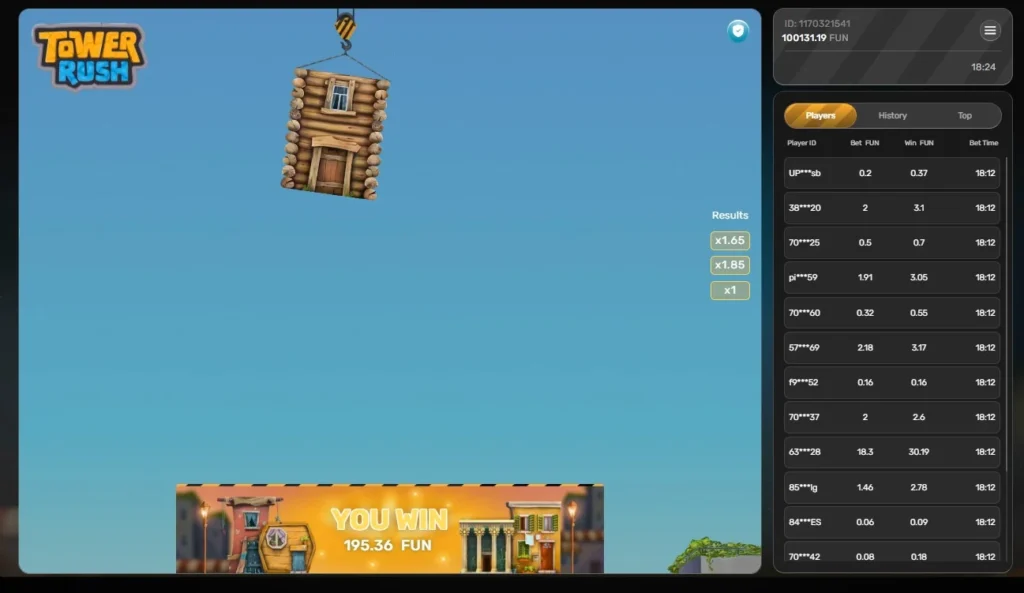
Players Who Used Demo Before Depositing
"I spent two full weeks in demo before depositing a cent. Mapped my ceiling at floor 9, tested three different cashout targets, learned that I tend to get reckless after a Frozen Floor. When I finally went live, my first ten sessions were all within budget. The demo time paid for itself immediately."
"The biggest thing I learned in demo: the game gets hard faster than you think. Those first five floors feel like nothing. Floor 8 onward is a different game entirely. I would've burned through $50 learning that lesson with real money."
"I tracked 60 demo rounds in a spreadsheet. Cashout at x5 produced positive net results in 7 out of 10 sessions. Cashout at x8 produced higher total returns but was positive only 5 out of 10 sessions. That data made my strategy choice obvious."
"Demo taught me that the Triple Build is the best moment to cash out, not the best moment to keep building. Every time I tried to extend after the three free floors, I lost the bonus gains more often than not. In real money, I always take the Triple Build and run."
"My advice is simple: play demo on the same device you'll use for real money. I practiced on my laptop but play real money on my phone. The timing is different and it took a few paid sessions to readjust. Should've done the demo on mobile from the start."
From Demo to Real Money: When and How
The demo doesn’t have a graduation ceremony. There’s no test to pass, no minimum rounds to complete. The transition is entirely the player’s decision. But some readiness indicators help.
Signs that the transition makes sense:
- Cashout target produces consistent positive results over 3+ simulated sessions
- Bonus reactions are deliberate rather than impulsive
- The precision ceiling is clearly identified and the cashout range stays below it
- A realistic budget has been determined based on entertainment spending, not income targets
Signs that more demo time would help:
- Cashout targets change frequently between rounds based on emotion rather than plan
- Towers consistently collapse because of chasing higher multipliers rather than a precision failure
- Session length isn’t controlled, with “just one more round” extending play beyond intended limits
- The motivation to switch to real money is driven by a desire to win money rather than an understanding that Tower Rush is entertainment with a cost
Tower Rush is a gambling product. The house maintains a 3-4% mathematical edge. Demo play eliminates the financial cost while preserving the gameplay experience. There’s no rush to transition. The game will be there tomorrow.
Problem gambling support: US 1-800-522-4700 | UK 0808 8020 133 | AU 1800 858 858 | NZ 0800 654 655.
Frequently Asked Questions
Mechanically identical. Same physics, same bonuses, same RTP, same RNG. The only difference is that demo credits have no monetary value and cannot be withdrawn.
On most platforms, no. Demo access is available directly from the game page without registration. Some casinos require a free account.
Until you have a consistent strategy that produces sustainable results over multiple simulated sessions. For most players, 1-3 weeks of occasional demo play provides sufficient data.
Yes. Most platforms allow toggling between modes from the game interface. Progress in one mode doesn't affect the other.
Yes. The same RNG algorithm governs bonus distribution in both modes. Frozen Floor, Temple Floor, and Triple Build appear at identical rates.
No. Credits reset when depleted. Session length is unlimited. There are no restrictions on demo play duration or frequency.

Scarlett Lewis
Lead Game Strategist & iGaming Behaviorist
Our Rating — 4.3/5
Tower Rush earns its highest rating specifically because of the demo mode. In a market where most crash games offer minimal practice opportunities, Tower Rush’s complete free play version gives players an authentic environment to develop skills, test strategies, and understand their own behavioral patterns before any money changes hands.
The four-phase testing protocol outlined here isn’t just theory. Players who follow it consistently report smoother transitions to real-money play, longer-lasting budgets, and fewer impulsive decisions during paid sessions.
The demo doesn’t eliminate the house edge. It doesn’t guarantee profits. What it does is give the player every possible advantage that the game’s design allows. In a genre where most competitors offer nothing between “watch a trailer” and “deposit now,” Tower Rush’s approach stands out.
Try it. There’s literally nothing to lose.
Rating: 4.3 / 5 ⭐⭐⭐⭐

 English
  French
  Italian
  Polish
  Portuguese
  Czech
Czech  Spanish